

SRS gear isn't something I have a huge amount of experience with so I've got a few questions if anyone can assist.
Capacitors - how essential is it that they are on their rated value, say for a 5ft 65W needing an 8.4uF capacitor, would it matter is the cap was only measuring say 8uF.
What would happen if a capacitor that was drastically lower in value was used, or the 8.4uF one had failed, say something like 4 or 5uF? Would it just fail or struggle to strike?
What would happen if a much higher value capacitor than the one specified was fitted say if someone stuck a 12 or 15uF cap in place of the 8.4uF?
Tube EOL - what happens? Do they just rectify and eventually go out? Like any magnetic ballast I assume they wouldn't appreciate a rectifying lamp being left in place long term.
Questions about SRS
-
Beta 5
- Posts: 387
- Joined: Sun Jan 07, 2024 11:52 am
Questions about SRS
Fluorescent Forever
-
Slyspark

- Site Admin
- Posts: 3149
- Joined: Mon Feb 22, 2016 11:00 pm
- Location: Surrey
- Contact:
Re: Questions about SRS
CAP:
So, the capacitor used is essentisal for the tube to be able to strike. If the capacitance drops as it ages, the tube becomes harder to strike. I've never tried using an 8mfd cap where an 8.4 is required (mostly cos I have enough 8.4's that I've never needed to). I guess an 8 would probably still work, but other factors such as the age of the tube, the conditions in which it's being operated would be variables that would also affect it's operation. If you wanted to test this, you'd be best ensuring that everything else remains a constant if you want any kind of meaningful result.
Presumably, if you go OVER the required value, it'd work also, but again, going too far might have unintended consequences. I guess they picked the very specific value of 8.4mfd for good reason.
I've never tried using other caps, but now I'm intrigues enough to try it and as I run SRS in the workshop anyway, it;s easy enough to do.
It should be noted that the 8.4 will work on those Parmar ballasts that list 5, 6 & 8' tubes, but if you're using a 4' SRS ballast, the cap drops to 5.5mfd. I have a 3' SRS batten somewhere and I *think* this is also 5.5mfd, but I'd need to check that (which means I'd need to find it first).
EOL:
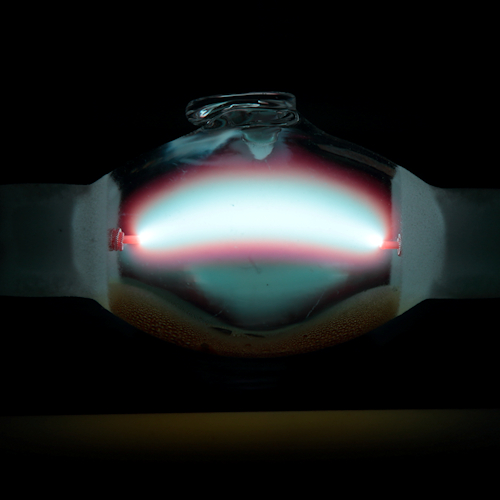
At EOL, the tube generally rectifies, you get a fantastic black sock at one end and assuming therte's no fuse or other protective measure to cut the tube out, you can get to the point of a rather spectacular failure where the cathode melts, the tube continues to rectify, using the metal cathode stem until the end of the tube gets so hot it either cracks, or the glass stem melts, vacuum is lost and it finally burns out. This can cause damage to the lampholder if it gets hot enough, especially if its made from one of the later, soft plastics, it'll literally melt! The ballast wonlt rerally appreciate this for very long either and gets HOT. Thorn especially, used to include a fuse in a little holder (either a loose barrel type fuse carrier, or within the terminal strip itself) designed to blow if the tube began to rectify. A rectifying tube will draw more current, hence why the fuse was a cheap and simple solution. They could be a VERY specific value - I have some here branded 'Churchouse' that are 1.25A and came out of something or other Thorn from back in the day.
It's quite cool to watch, you get a nice orange light show at one end of the tube, right as it finally fails. Just need to be in the right place at the right time.
So, the capacitor used is essentisal for the tube to be able to strike. If the capacitance drops as it ages, the tube becomes harder to strike. I've never tried using an 8mfd cap where an 8.4 is required (mostly cos I have enough 8.4's that I've never needed to). I guess an 8 would probably still work, but other factors such as the age of the tube, the conditions in which it's being operated would be variables that would also affect it's operation. If you wanted to test this, you'd be best ensuring that everything else remains a constant if you want any kind of meaningful result.
Presumably, if you go OVER the required value, it'd work also, but again, going too far might have unintended consequences. I guess they picked the very specific value of 8.4mfd for good reason.
I've never tried using other caps, but now I'm intrigues enough to try it and as I run SRS in the workshop anyway, it;s easy enough to do.
It should be noted that the 8.4 will work on those Parmar ballasts that list 5, 6 & 8' tubes, but if you're using a 4' SRS ballast, the cap drops to 5.5mfd. I have a 3' SRS batten somewhere and I *think* this is also 5.5mfd, but I'd need to check that (which means I'd need to find it first).
EOL:
At EOL, the tube generally rectifies, you get a fantastic black sock at one end and assuming therte's no fuse or other protective measure to cut the tube out, you can get to the point of a rather spectacular failure where the cathode melts, the tube continues to rectify, using the metal cathode stem until the end of the tube gets so hot it either cracks, or the glass stem melts, vacuum is lost and it finally burns out. This can cause damage to the lampholder if it gets hot enough, especially if its made from one of the later, soft plastics, it'll literally melt! The ballast wonlt rerally appreciate this for very long either and gets HOT. Thorn especially, used to include a fuse in a little holder (either a loose barrel type fuse carrier, or within the terminal strip itself) designed to blow if the tube began to rectify. A rectifying tube will draw more current, hence why the fuse was a cheap and simple solution. They could be a VERY specific value - I have some here branded 'Churchouse' that are 1.25A and came out of something or other Thorn from back in the day.
It's quite cool to watch, you get a nice orange light show at one end of the tube, right as it finally fails. Just need to be in the right place at the right time.
Bad choices make good stories!
-
FrontSideBus
- Posts: 1115
- Joined: Fri Aug 07, 2015 11:04 am
- Location: Liverpool
Re: Questions about SRS
Would be interesting to measure ocv, lamp voltage and current with different value caps.
-
Beta 5
- Posts: 387
- Joined: Sun Jan 07, 2024 11:52 am
Re: Questions about SRS
Thanks for the answers!
Yes, this is what I have been wondering, the specific value of 8.4uF must have been chosen for a reason. I may try putting some of my standard 8uF PFC caps on to see what the effect is, I guess if you could find an 8.5uF motor run capacitor that would do as the nearest equivalent, as I assume 8.4uF caps aren't made any more?
I do have a 1980s RIC 8.4uF which has dropped to only reading about 7.9...8uF, testing that it still seemed to strike ok (the tube is brand new though so may be somewhat harder to strike if well used), but the case of the capacitor did get noticeably warm, maybe 10+ degrees above ambient whereas the others were all stone cold.
I think that is probably more because that capacitor is failing rather than the fact its value is lower though.
Yes I have a couple of 5.5uF caps kicking around, I figured they were for lower wattage SRS, again it is a specific value rather than just using 5uF or 6uF so there must be a reason for it, perhaps it is just the optimal value for the circuit.
Another thing I found while experimenting, if you remove the capacitor from circuit after the tube has struck the brightness drops a little and the ballast quietens down a bit, the total circuit watts also reduced from 85W to 70W with the Transtar KL65, so the capacitor must still be active in the circuit after the tube has struck.
Ok that's pretty much what I was expecting for EOL, I have seen some very hammered EOL T12's so I guess those would have been victim to an SRS EOL! If left rectifying for long enough I suppose they would mercury migrate too?
I've seen those fuse holders in a few fittings actually, the Marlin 22w circular bulkheads also contain one, again at a funny value something like 3.15A if I recall. A 22w Circline will rectify once the cathode breaks so the starter can't interrupt it.
Yes, this is what I have been wondering, the specific value of 8.4uF must have been chosen for a reason. I may try putting some of my standard 8uF PFC caps on to see what the effect is, I guess if you could find an 8.5uF motor run capacitor that would do as the nearest equivalent, as I assume 8.4uF caps aren't made any more?
I do have a 1980s RIC 8.4uF which has dropped to only reading about 7.9...8uF, testing that it still seemed to strike ok (the tube is brand new though so may be somewhat harder to strike if well used), but the case of the capacitor did get noticeably warm, maybe 10+ degrees above ambient whereas the others were all stone cold.
I think that is probably more because that capacitor is failing rather than the fact its value is lower though.
Yes I have a couple of 5.5uF caps kicking around, I figured they were for lower wattage SRS, again it is a specific value rather than just using 5uF or 6uF so there must be a reason for it, perhaps it is just the optimal value for the circuit.
Another thing I found while experimenting, if you remove the capacitor from circuit after the tube has struck the brightness drops a little and the ballast quietens down a bit, the total circuit watts also reduced from 85W to 70W with the Transtar KL65, so the capacitor must still be active in the circuit after the tube has struck.
Ok that's pretty much what I was expecting for EOL, I have seen some very hammered EOL T12's so I guess those would have been victim to an SRS EOL! If left rectifying for long enough I suppose they would mercury migrate too?
I've seen those fuse holders in a few fittings actually, the Marlin 22w circular bulkheads also contain one, again at a funny value something like 3.15A if I recall. A 22w Circline will rectify once the cathode breaks so the starter can't interrupt it.
Fluorescent Forever
-
Alex

- Posts: 88
- Joined: Mon Jan 13, 2025 2:10 pm
- Location: Freiberg/Sachsen-Germany
Re: Questions about SRS
I personally have no expereince with SRS. A SRS Ballast is on my wanted list however so I can anlayse it and hopefully try (An in best case succeed) to understand it.
To my (limited) understanding the starting circuit is tuned. The inductance of the ballast and the capacitor form a resonance circuit. This generates the high voltage necessary to strike the lamp. When the capacitance is above a below the the necessary value the circuit is out of tune and the voltage decreases.
To my (limited) understanding the starting circuit is tuned. The inductance of the ballast and the capacitor form a resonance circuit. This generates the high voltage necessary to strike the lamp. When the capacitance is above a below the the necessary value the circuit is out of tune and the voltage decreases.
From Germany. Open for any trades. Especially interested in british lighting. Please ask questions!
Favorite Lamp manufacturer: GEC
Favorite Lamp manufacturer: GEC
-
Nick217
- Posts: 459
- Joined: Mon Nov 09, 2015 2:31 pm
Re: Questions about SRS
If you're over for the summer meet I'm sure an srs fitting can be obtained for you.I personally have no expereince with SRS. A SRS Ballast is on my wanted list however so I can anlayse it and hopefully try (An in best case succeed) to understand it.
To my (limited) understanding the starting circuit is tuned. The inductance of the ballast and the capacitor form a resonance circuit. This generates the high voltage necessary to strike the lamp. When the capacitance is above a below the the necessary value the circuit is out of tune and the voltage decreases.
-
Alex
- Posts: 88
- Joined: Mon Jan 13, 2025 2:10 pm
- Location: Freiberg/Sachsen-Germany
Re: Questions about SRS
I sure plan to be there 
From Germany. Open for any trades. Especially interested in british lighting. Please ask questions!
Favorite Lamp manufacturer: GEC
Favorite Lamp manufacturer: GEC
-
Liam

- Posts: 107
- Joined: Sat Aug 08, 2015 4:36 pm
Re: Questions about SRS
From experience SRS can be very temperamental with what tubes and Caps they have in the circuit. Best to just stick with the rated caps that's stated on the ballasts tbh.
Some SRS don't like certain tubes too i've found esp Triphosphor Holland Philips T12's, they will work for a while bu then have the odd days of just sat there glowing at the ends until the switch is flicked off and on.
Some SRS don't like certain tubes too i've found esp Triphosphor Holland Philips T12's, they will work for a while bu then have the odd days of just sat there glowing at the ends until the switch is flicked off and on.
-
Beta 5
- Posts: 387
- Joined: Sun Jan 07, 2024 11:52 am
Re: Questions about SRS
I just had a little mess around with some different capacitors, with a brand new tube and an 8.4uF cap it started near enough instantly. Fitting a standard 8uF 250V cap (of the type usually used a PFC capacitor) it started ok though there was a slight shimmer for a brief moment before it struck. I then tried a 6uF capacitor of the same type which did struggle to start and shimmered for 3-4 seconds before the tube got lit.
Of course with a well used lamp, cooler ambient temperature, humidity etc it may well struggle even more or not start at all. Next to try is an 8.5uF motor run cap when I find one, I expect that will work fine as it is likely within the tolerance range specified on the proper 8.4uF ones.
I do have several of the proper 8.4uF capacitors but given how film capacitors like these tend to like to fail after a few years use depending on the brand, having alternatives available is good to know about.
Of course with a well used lamp, cooler ambient temperature, humidity etc it may well struggle even more or not start at all. Next to try is an 8.5uF motor run cap when I find one, I expect that will work fine as it is likely within the tolerance range specified on the proper 8.4uF ones.
I do have several of the proper 8.4uF capacitors but given how film capacitors like these tend to like to fail after a few years use depending on the brand, having alternatives available is good to know about.
Fluorescent Forever
-
Slyspark
- Site Admin
- Posts: 3149
- Joined: Mon Feb 22, 2016 11:00 pm
- Location: Surrey
- Contact:
Re: Questions about SRS
That's the best bit about SRS tho - the shimmer as it fades up!
Bad choices make good stories!
Return to “Fluorescent Lighting”
Who is online
Users browsing this forum: No registered users