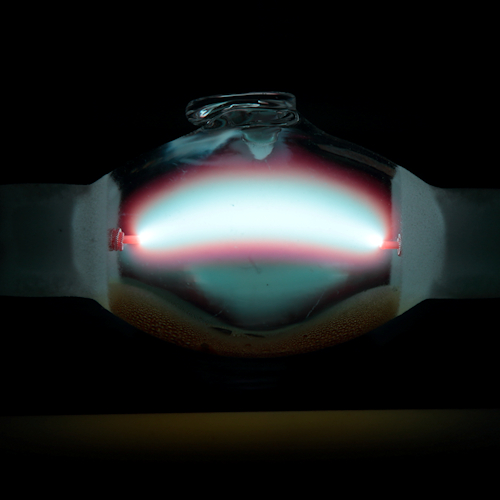
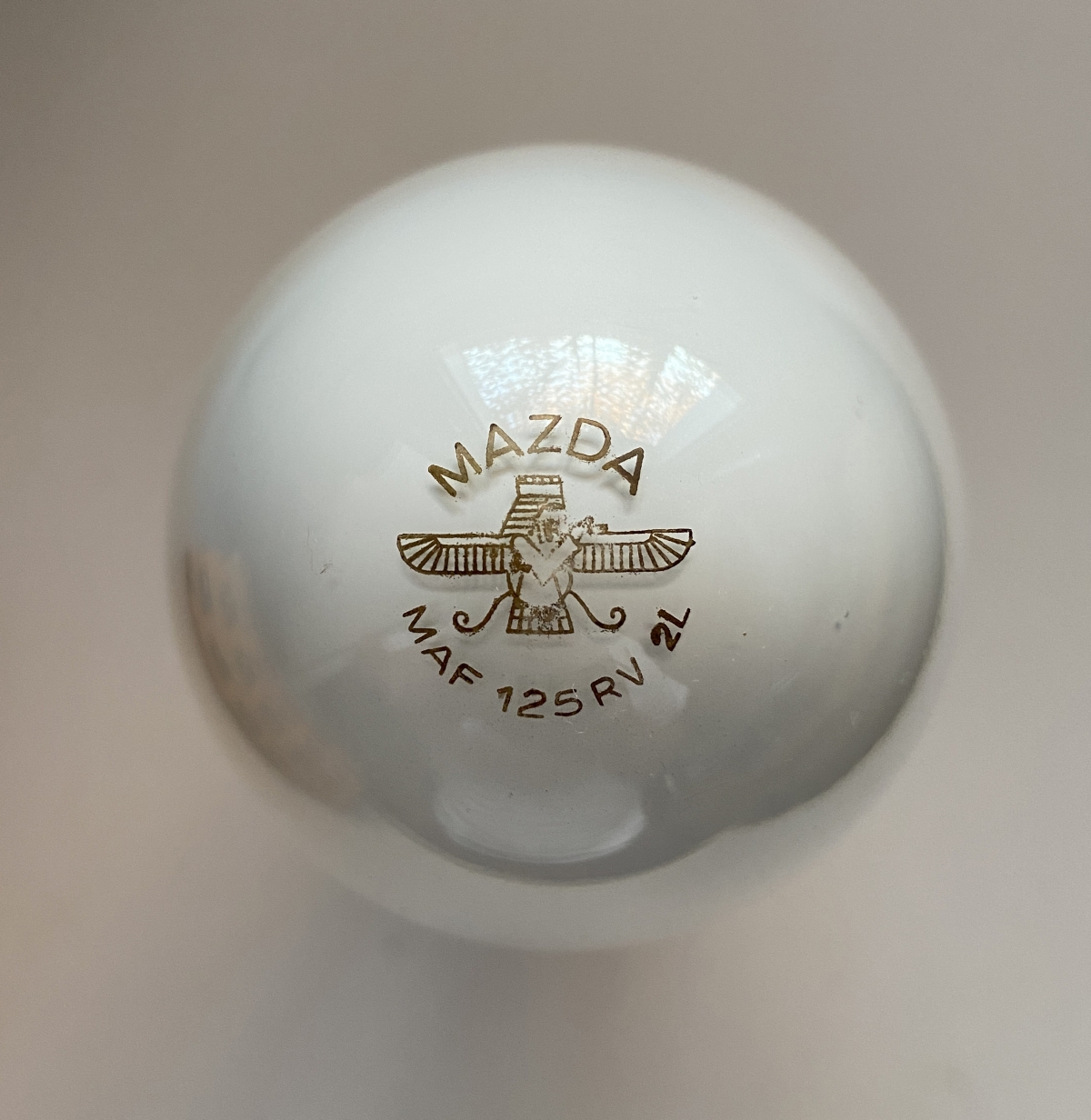
МЭЛЗ ДРЛ 500 M (MELZ DRL 500 M)

Anything to do with discharge lamps mercury, SON, SOX etc and their control gear! Do you just need information on how to run a lamp correctly? Post it here!
User avatar
Olav
Posts: 42
Joined: Wed Nov 10, 2021 2:28 pm
Location: Hamburg, Germany

Re: МЭЛЗ ДРЛ 500 M (MELZ DRL 500 M)

Postby Olav » Mon Jan 03, 2022 7:27 am

Hello everyone,

I would like to expand the article.
The following is the complete Russian text on the problems with the production of the first DRL lamps at the beginning in Moscow.
This is followed by diagrams and photos.
A plausible translation of the text is possible with a translator.
Ash, do you have the time for a translation, please ? That would be great.

ДРЛ в Советском Союзе и России

Немногие из нас иногда, но задумывались — а собственно, как пришли к тому, чтобы делать ДРЛ.
Еще меньшее число задавалось вопросом — а когда и как начали делать эти лампы в нашей стране. Попробуем расставить все точки над


На дворе 1956 год — на Московском электроламповом заводе уже 10 лет успешно делают люминесцентные лампы(не исключено, что без зарубежной «помощи» тут не обошлось).
Мощностей не хватает, поэтому в Смоленске, Полтаве, Ереване и Саранске парой лет спустя начинают строительство и ввод в эксплуатацию новых предприятий ламповой промышленности.
Но именно в 1956 году, в Москве начинается производство Дуговых ламп высокого давления с люминофорным покрытием.

Обратимся к предыстории. Первые лампы высокого давления были разработаны еще в конце 1930-х годов, но они не имели ни изотермической колбы,
ни люминофорного покрытия — горелка из кварца помещенная в классическую колбу стандарта «А». Потом была война, и разработки в сфере освещения по сути прекратились.
Первые лампы с покрытием светорассеивающим составом можно датировать концом 1940-х годов.
Но как мы все знаем, ртуть в своей основе излучает в сине-зеленой части видимого спектра и в ультрафиолетовой его области,
и годится в «голом» виде разве что для освещения в тех случаях, когда нет требований к цветопередаче.
Решение нашлось достаточно простое и элегантное — покрыть внешнюю защитную колбу лампы люминофором,
способным исправлять цвет свечения, внося в него красную линию спектра.
Ведь основной световой поток лампы создается непосредственно дугой в горелке, а люминофор нужен только для придания свету приемлемой цветопередачи.

Но мало покрыть колбу лампы люминофором — нужно обеспечить максимальную стабильность параметров в период всей работы лампы.
Поэтому люминофоры разрабатывались на основе редкоземельных металлов и должны были быть термостойкими,
устойчивыми к воздействию жесткого ультрафиолета обильно излучаемого горелкой. Так родилась изотермическая колба — колба особой формы,
в которой обеспечивалась бы максимальная конвекция газов, для недопущения перегрева отдельных участков и для более равномерного износа люминофора.

Теперь поговорим о конструкции самой горелки — к ней выдвигалось требование быть устойчивой к повышению давления в следствии высокой температуры внутренней среды,
ибо изначально в выключенной лампе давление равняется атмосферному. Идеальным материалом стал кварц. Электроды так же обязаны были быть устойчивы к износу.
Электроды это вообще отдельная «песня» — найти материал одинакового температурного расширения с кварцем было сильной головной болью.
Но помимо того, нужно было организовать впай поджигающего электрода, ионизирующего разрядный промежуток, для успешного запуска лампы от сетевого напряжения.
Ибо в противном случае необходим импульс высокого напряжения для пробоя газового промежутка.

Параллельно с лампами были придуманы балластные устройства — дросселя, способные обеспечивать в лампе на протяжении всего ее периода работы номинальный ток,
ибо все разрядные лампы обладают отрицательной вольт-амперной характеристикой. А это означает, что ток в разрядном промежутке будет расти до условно неограниченной величины,
что приведет к разрушению устройства. Точнее говоря, были доработаны дросселя для люминесцентных ламп.

И вот мы плавно подошли к тому, с чего начали — Советский Союз всегда копировал свои изделия с чужих — так проще, особенно в условиях послевоенной нестабильности, продолжавшейся до 1960-х.
И с газоразрядными лампами история была та же самая.

Опыт производства ртутных ламп в СССР ограничивался копиями зарубежных ламп среднего давления под названиями ИГАР и ИГАР-2 и полумифической СВД-250, а так же лампами медицинского назначения.
Но если в лампах среднего давления использовалось тугоплавкое боросиликатное стекло, в котором выполнить поджигающий электрод было сложно но возможно, то кварц на тот момент производился в виде ламп серии ПРК.
А им, как известно, поджигающий электрод не требовался — они запускались импульсом ЭДС возникавшей в дросселе в следствии замыкания его накоротко.
Столкнувшись с такой проблемой было решено создать лампу на подобии ПРК, но помещенной во внешнюю колбу. Двухэлектродная ДРЛ.
А для пробоя газового промежутка сделать специальный дроссель с запускающим устройством получивший наименование ПУРЛ.
Линейка мощностей была представлена лампами на 250, 500, 750 и 1000 Ватт.
Специальных светильников со встроенными дросселями на тот момент еще не производилось,
да и сложно было представить фонарные опоры стилистики сталинского неоклассицизма с непонятными устройствами на них,
поэтому пошли по пути наименьшего сопротивления — устанавливать дроссель с ПУРЛ в специальном кожухе на опоре, а в имевшиеся установленные и производимые светильники крутить лампы.
Система была капризная, малонадежная. Но она показывала свою эффективность по сравнению с люминесцентными системами уличного освещения, зародившимися примерно в то же время, не говоря о лампах накаливания.
Так началось шествие ДРЛ по просторам СССР.

Ненадежность всей общей системы из дросселя, поджигающего устройства и отнесенной от них лампы кричали о том, что нужно вести работу дальше.
И работа велась — в 1963 или 1964 году в Москве удалось преодолеть проблему поджигающего электрода и размещения его в горелке.
Это стало новой вехой. Помимо того, на Лихославльском заводе Водомер(в будущем ЛЗСИ) начали производство светильников изначально предназначенных для использования с ДРЛ.
На некоем заводе в Новосибирске, в 1961 году началось производство светильников серии СКЗПР — легенды, продержавшейся на конвейере практически 30 лет.
Но один МЭЛЗ не мог справиться с тем, чтобы обеспечить весь СССР новыми источниками света, и поэтому в 1964 году, практически сразу же после начала производства четырехэлектродных ламп в Москве,
в Саранск на запущенный в 1958 году СЭЛЗ, отправилась делегация с рассмотрением возможности размещения производственных мощностей там.

Доподлинно не известно, закупалось ли оборудование за рубежом, или же МЭЛЗ передал часть производственных мощностей, но точно можно сказать — в 1965-66 году,
в Саранске начинается производство ДРЛ, имеющих некоторые черты московских ламп.
На конец 1960-х картина складывалась примерно такая: в Саранске делают четырехэлектродные лампы на 250 и 400 ватт, осваивая 80 и 125,
в Москве же делают всю линейку мощностей двухэлектродных ламп и все ходовые мощности четырехэлектродных ламп, осваивая ДРИ и новую модель — 2000 ватт.
При этом происходит интересная вещь — колбы старых типов мощностей сдвигаются на 1 ступень — то что было двухэлектродной 1000 с небольшими изменениями пропорции колбы стало 2000, 750 стала 1000,
500 стала 700 а от 250 колба досталась 400. Двухэлектродные лампы получают индекс «М». Попутно в Лихославле разрабатывают новые серии светильников под новые лампы.

В 1968 году происходят перетурбации в системе устройств заводов и появляются производственные объединения — в Саранске это «Светотехника» а в Москве это МЭЛЗ.
Да-да, МЭЛЗ с 1968 года это ПО, а завод на Электрозаводской именуется МЗЭВП — Московский завод электровакуумных приборов.
В 1971-2 году производство двухэлектродных ламп сворачивается, как неперспективное направление, вводится в строй Полтавский завод газоразрядных ламп,
где так же начинают делать ДРЛ двух основных ходовых мощностей — 250 и 400 ватт. В Саранске осваивают производство 700 и 1000 ватт. А МЭЛЗ наоборот сворачивает часть производства — лампы на125 Ватт,
не вышедшие за рамки экспериментальных и переданные на производство в Саранск, 250 и 400 ватт перестают выпускаться, но при этом в производстве остаются 700 и 1000.
таковой картина оставалась до самых 1990-х, разве что за прекращением в 1980-82 году производства ДРЛ 2000. Лампы проходили усовершенствования, появлялись новые люминофоры,
типы производства горелок и материалы электродов. С 1979-80 года помимо информации о типе и мощности с датой производства, начали указывать Красное Отношение — то есть,
насколько у лампы люминофор способен корректировать излучение горелки, исправляя цветность. В 1988-м году осваивают новую мощность — 50 ватт, а в 1986-87 новый люминофор с КО=15.
Даже Ереван не оказался в стороне, и для производимой на ПО «Луйс» серии ЖКУ и РКУ07 начал производство натриевых и ртутных ламп малых мощностей.
Но случился 1991 год. В 1993-4-м году на МЭЛЗ восстанавливают производство ламп малых мощностей 250 и 400 Ватт,
попутно снижая производство мощных ламп — это можно расценивать как попытку перехода завода на самоокупаемость в новых условиях.
Агония гиганта длившаяся до 2007 года. Полтава находясь на территории суверенного государства идет по своему пути развития. А в Саранске начинается постепенная деградация продукции,
приведшая к возникновению в 2005 году серии «М» и, по сути, закату производства ДРЛ на территории России.

А с 2020 года ламп ДРЛ больше не будет. От слова совсем.

Большое спасибо за внимание.


Thats the complete text in Russian language about the DRL-M lamps.
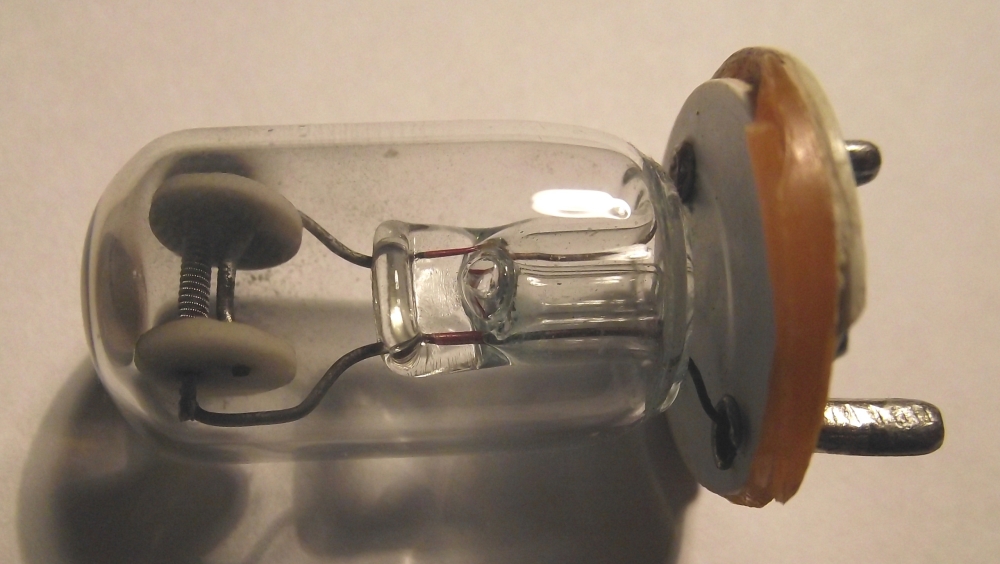
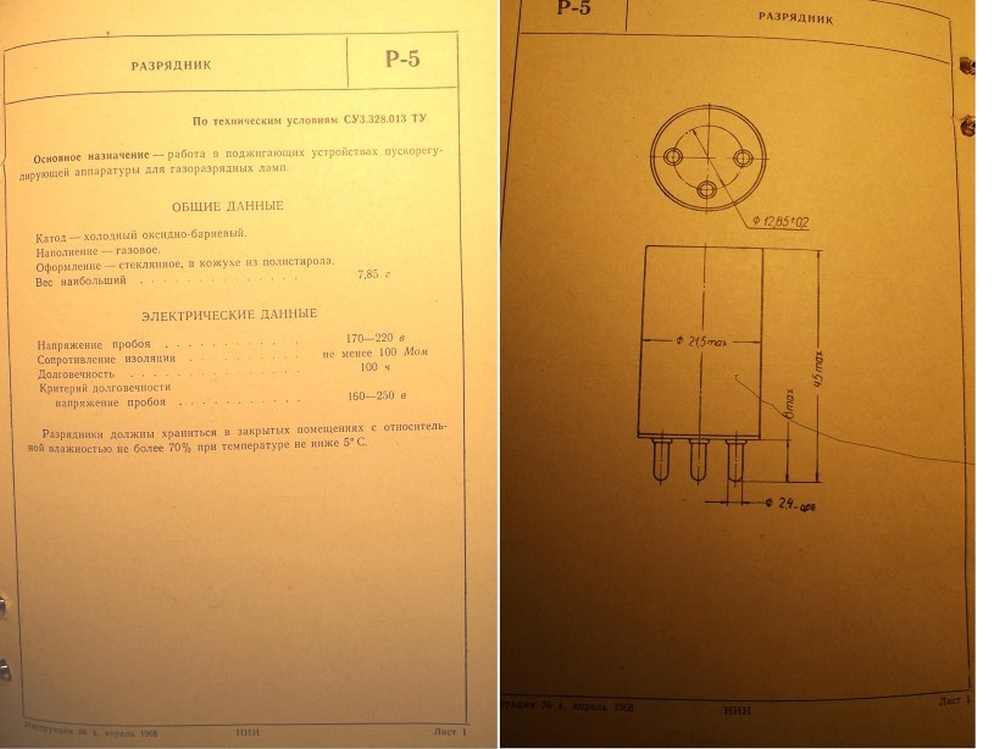
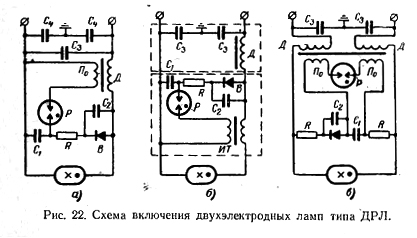
The following pictures show a page from a book, circuit diagrams and the starter of the ignitor.
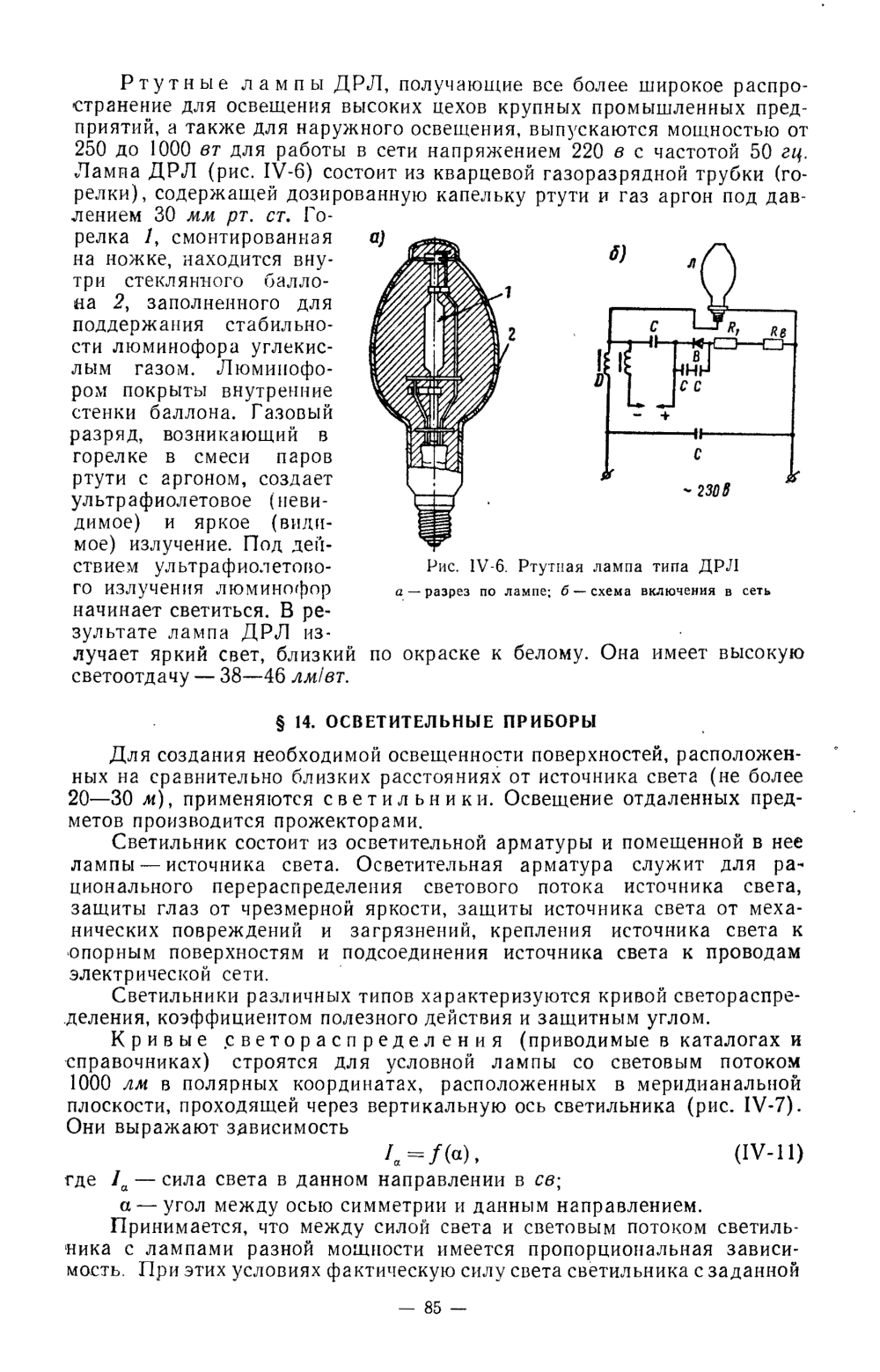
Image


Image


Image

Gas filled spark gap "P-5"


Image

Technical data gas filled spark gap "P-5"

Thanks to Michail Leonow for sharing the pics from "P-5".

Here you can see pics from a complete unit with ballast and starter for a DRL-M 250: 1АПИ-250-ДРЛ/220


Regards

Olav
Last edited by Olav on Tue Jan 04, 2022 8:49 pm, edited 1 time in total.
User avatar
Olav
Posts: 42
Joined: Wed Nov 10, 2021 2:28 pm
Location: Hamburg, Germany

Re: МЭЛЗ ДРЛ 500 M (MELZ DRL 500 M)

Postby Olav » Tue Jan 04, 2022 2:43 pm

Hello everyone,

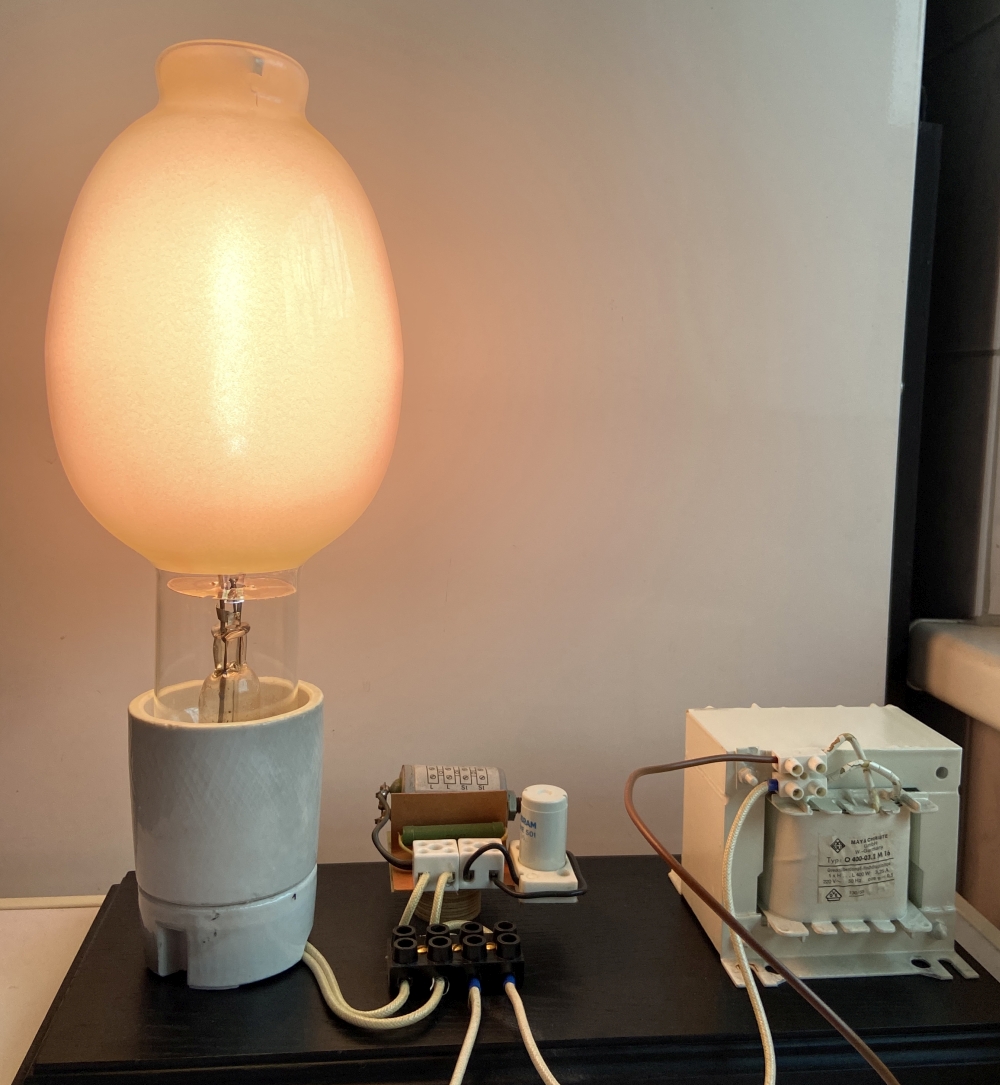
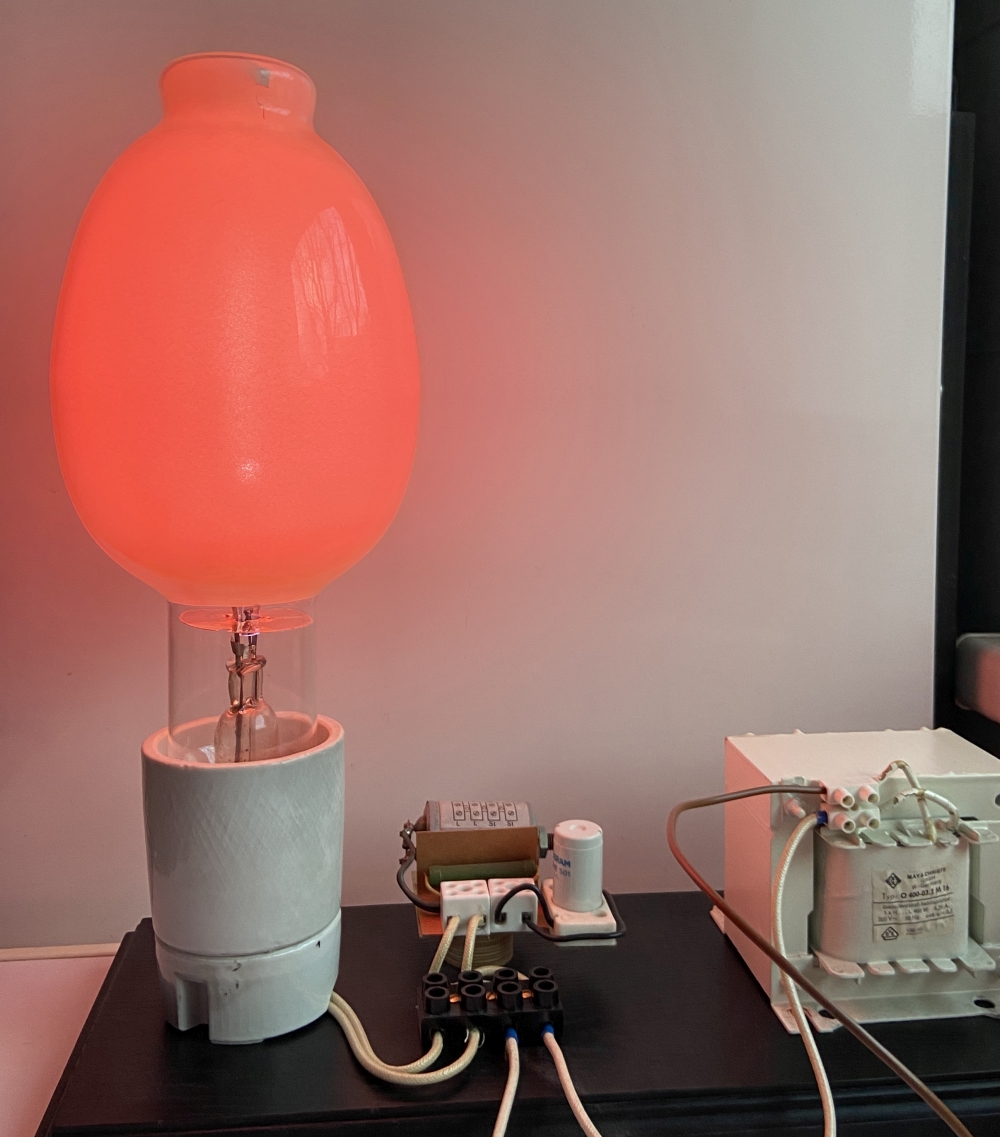
today I ignited the lamp with an improvised circuit. An unused May & Christe ballast for a 400W mv lamp and an OSRAM StE 501 starter are used.

You can no longer get a ballast for a 500W mv lamp. The lamp runs with a little underload.

Image

A few seconds after the ignition


Image

About 15 seconds after the ignition.


Regards

Olav
User avatar
Andy
Site Admin
Posts: 412
Joined: Tue Aug 04, 2015 8:36 pm
Location: England

Re: МЭЛЗ ДРЛ 500 M (MELZ DRL 500 M)

Postby Andy » Tue Jan 04, 2022 7:03 pm

Great to see that you have managed to light this 500W lamp Olav!
It is most likely one of the rarer lamps to be lit this year.
Thanks for sharing this. ;cool
User avatar
Ash
Posts: 399
Joined: Sat Dec 02, 2017 9:42 pm

Re: МЭЛЗ ДРЛ 500 M (MELZ DRL 500 M)

Postby Ash » Tue Jan 04, 2022 8:33 pm

I will have a look at it over the weekend

Meanwhile, the schematics of the ignition circuit are not too different from those of SON ignitors

The ones with replacable spark gap (the "starter" which isn't really a glow starter) - I havent opened one, but they are probably of similar construction to the 2nd schematic

Modern ballast dependent ignitors are similar to the 1st, except the electronic circuit is flipped such that the pulse winding primary is reduced to a single tap on the main ballast winding, and a SIDAC replaces the spark gap device
User avatar
SilverRay
Posts: 8
Joined: Thu Nov 11, 2021 9:42 am
Location: Moscow, Russia

Re: МЭЛЗ ДРЛ 500 M (MELZ DRL 500 M)

Postby SilverRay » Tue Jan 04, 2022 8:35 pm

Only one note, Olav.
P-5 is not a starter as bi-metal interrupter. This is a gas filled spark gap.
User avatar
Olav
Posts: 42
Joined: Wed Nov 10, 2021 2:28 pm
Location: Hamburg, Germany

Re: МЭЛЗ ДРЛ 500 M (MELZ DRL 500 M)

Postby Olav » Tue Jan 04, 2022 8:53 pm

Hello Ash and Roman,

thank you for all additions. The text has been corrected and I removed bugs.

Regards

Olav
User avatar
Ash
Posts: 399
Joined: Sat Dec 02, 2017 9:42 pm

Re: МЭЛЗ ДРЛ 500 M (MELZ DRL 500 M)

Postby Ash » Sun Jan 09, 2022 9:04 pm

Just a heads up. I started translating it, but am busy in the next few days. I will complete it later
User avatar
Olav
Posts: 42
Joined: Wed Nov 10, 2021 2:28 pm
Location: Hamburg, Germany

Re: МЭЛЗ ДРЛ 500 M (MELZ DRL 500 M)

Postby Olav » Sun Jan 09, 2022 9:10 pm

Hello Ash,

please don't rush. Everything is here voluntarily.
Thank you for your willingness to complete this.

Regards

Olav
User avatar
FrontSideBus
Posts: 1096
Joined: Fri Aug 07, 2015 11:04 am
Location: Liverpool

Re: МЭЛЗ ДРЛ 500 M (MELZ DRL 500 M)

Postby FrontSideBus » Sun Jan 09, 2022 10:09 pm

Awesome!
User avatar
Olav
Posts: 42
Joined: Wed Nov 10, 2021 2:28 pm
Location: Hamburg, Germany

МЭЛЗ ДРЛ 500 M (MELZ DRL 500 M)

Postby Olav » Mon Apr 13, 2026 7:06 am

It was quite some time ago. I’ve now translated the text from Russian using Deepl. It’s reasonably clear, so I can follow the development of the ДРЛ -M lamps.

Fluorescent lamps in the Soviet Union and Russia

Few of us have ever stopped to wonder—how on earth did we come to manufacture fluorescent lamps?
Even fewer have asked themselves when and how the production of these lamps began in our country. Let’s try to dot the i’s and cross the t’s

It is 1956 – the Moscow Electric Lamp Factory has already been successfully manufacturing fluorescent lamps for 10 years (it is quite possible that this would not have been possible without foreign ‘assistance’).
Capacity was insufficient, so a couple of years later, construction and commissioning of new lamp manufacturing plants began in Smolensk, Poltava, Yerevan and Saransk.
But it was precisely in 1956 that production of high-pressure arc lamps with a phosphor coating began in Moscow.

Let us look back at the background. The first high-pressure lamps were developed as early as the late 1930s, but they had neither an isothermal bulb
nor a phosphor coating — a quartz burner housed in a standard ‘A’ bulb. Then came the war, and developments in the field of lighting effectively ceased.
The first lamps with a light-diffusing coating date back to the late 1940s.

But as we all know, mercury essentially emits light in the blue-green part of the visible spectrum and in the ultraviolet region,
and in its ‘bare’ form is suitable for lighting only in situations where there are no colour rendering requirements.
A fairly simple and elegant solution was found — to coat the lamp’s outer protective bulb with a phosphor
capable of correcting the colour of the light by introducing the red part of the spectrum.
After all, the lamp’s main luminous flux is generated directly by the arc in the burner, and the phosphor is needed only to give the light acceptable colour rendering.

However, simply coating the lamp bulb with a phosphor is not enough—it is necessary to ensure maximum stability of the parameters throughout the lamp’s entire operational life.
For this reason, phosphors were developed using rare-earth metals and had to be heat-resistant,
as well as resistant to the harsh ultraviolet radiation emitted in abundance by the burner. This led to the development of the isothermal bulb — a bulb of a special shape,
designed to ensure maximum gas convection, thereby preventing overheating of individual sections and ensuring more uniform wear of the phosphor.

Now let’s talk about the design of the burner itself — it had to be able to withstand the rise in pressure caused by the high internal temperature,
as the pressure inside the lamp is initially equal to atmospheric pressure when it is switched off. Quartz proved to be the ideal material. The electrodes also had to be wear-resistant.
The electrodes are a whole other story — finding a material with the same coefficient of thermal expansion as quartz was a real headache.
But apart from that, it was necessary to incorporate an ignition electrode, which ionises the discharge gap, to ensure the lamp could be successfully started from mains voltage.
Otherwise, a high-voltage pulse would be required to break down the gas gap.

At the same time as the lamps, ballast devices—chokes—were invented, capable of maintaining the rated current in the lamp throughout its entire operating life,
since all discharge lamps have a negative current-voltage characteristic. This means that the current in the discharge gap would rise to a theoretically unlimited value,
which would lead to the destruction of the device. More precisely, chokes for fluorescent lamps were developed.

And so we have come full circle to where we started — the Soviet Union always copied its products from others; it was simply easier that way, especially given the post-war instability that persisted until the 1960s.
And the story was exactly the same with gas-discharge lamps.

Experience in the production of mercury lamps in the USSR was limited to copies of foreign medium-pressure lamps under the names IGAR and IGAR-2, the semi-legendary SVD-250, and lamps for medical use.
However, whilst medium-pressure lamps used refractory borosilicate glass, in which it was difficult but possible to form a starter electrode, quartz was at that time produced in the form of the PRK series of lamps.
And, as is well known, these did not require a starter electrode — they were triggered by an EMF pulse generated in the choke as a result of short-circuiting it.
Faced with this problem, it was decided to create a lamp similar to the PRK, but housed in an outer bulb. The two-electrode DRL.
And to create a gas gap breakdown, a special choke with a starting device was developed, which was named the PURL.
The range of power ratings included lamps of 250, 500, 750 and 1000 watts.
Special luminaires with built-in chokes were not yet being produced at that time,
and it was difficult to imagine street lamp posts in the Stalinist neoclassical style with obscure devices mounted on them,
so they took the path of least resistance — installing a ballast with a PURL in a special housing on the post, and fitting the lamps into the existing and newly manufactured luminaires.
The system was temperamental and unreliable. But it proved its effectiveness compared to fluorescent street lighting systems, which had emerged around the same time, not to mention incandescent lamps.
Thus began the march of DRL across the vast expanses of the USSR.

The unreliability of the entire system—comprising the choke, the ignition device and the lamp mounted separately from them—made it abundantly clear that further work was needed.
And work did continue: in 1963 or 1964, in Moscow, the problem of the ignition electrode and its placement within the burner was successfully resolved.
This marked a new milestone. In addition, the Vodomer factory in Likhoslavl (later LZSI) began manufacturing luminaires originally intended for use with DRLs.
At a certain factory in Novosibirsk, production of the SKZPR series of luminaires began in 1961 — a legendary product that remained on the production line for almost 30 years.
But one MELZ could not cope with supplying the entire USSR with new light sources, and so in 1964, almost immediately after the start of production of four-electrode lamps in Moscow,
a delegation was sent to Saransk to the SELZ, which had been launched in 1958, to consider the possibility of locating production facilities there.

It is not known for certain whether the equipment was purchased abroad or whether MELZ transferred part of its production capacity, but one thing is certain: in 1965–66,
production of DRLs began in Saransk, which shared certain features with the Moscow lamps.
By the end of the 1960s, the situation was roughly as follows: in Saransk, they were manufacturing 250- and 400-watt four-electrode lamps, whilst developing 80- and 125-watt models,
whereas in Moscow, they were producing the full range of two-electrode lamp power ratings and all the standard power ratings of four-electrode lamps, whilst developing DRI lamps and a new 2000-watt model.
At the same time, an interesting shift is taking place — the bulbs of the old power ratings are being moved up one step: what was a 1000-watt two-electrode bulb, with slight changes to the bulb’s proportions, has become a 2000-watt bulb; the 750-watt has become a 1000-watt;
the 500-watt has become a 700-watt; and the 250-watt bulb has been reclassified as a 400-watt. Two-electrode lamps are given the ‘M’ index. Meanwhile, in Likhoslavl, new series of luminaires are being developed to accommodate the new lamps.

In 1968, there were upheavals in the factory organisation system, leading to the emergence of production associations – in Saransk this was ‘Svetotechnika’, and in Moscow it was MELZ.
Yes, since 1968, MELZ has been a production association, whilst the factory on Elektrozavodskaya Street is known as MZEVP — the Moscow Plant of Electrovacuum Devices.
In 1971–72, the production of two-electrode lamps was phased out as an unpromising line of business, and the Poltava Gas Discharge Lamp Plant was commissioned,
where they also began manufacturing gas discharge lamps in the two main power ratings — 250 and 400 watts. In Saransk, production of 700 and 1000-watt lamps was established. Meanwhile, MELZ, on the other hand, scaled back part of its production — 125-watt lamps,
which had not progressed beyond the experimental stage and were transferred to production in Saransk, production of 250 and 400 watt lamps ceased, whilst 700 and 1000 watt models remained in production.
This situation persisted until the 1990s, with the sole exception being the discontinuation of 2000 watt DRL production in 1980–82. The lamps underwent improvements, with new phosphors,
types of burner production and electrode materials appearing. From 1979–80, in addition to information on the type and power rating along with the date of manufacture, the ‘Red Ratio’ began to be indicated — that is,
the extent to which the lamp’s phosphor is capable of correcting the burner’s radiation, adjusting the colour. In 1988, a new wattage of 50 watts was introduced, and in 1986–87 a new phosphor with a Red Ratio of 15.

Even Yerevan was not left out, and began manufacturing low-wattage sodium and mercury lamps for the ZhKU and RKU07 series produced at the ‘Luys’ Plant.
But then came 1991. In 1993–94, production of low-power 250- and 400-watt lamps was resumed at the MELZ,
whilst production of high-power lamps was scaled back — this can be seen as an attempt by the plant to become self-sustaining under the new conditions.
The giant’s agony lasted until 2007. Poltava, situated within a sovereign state, is following its own path of development. Meanwhile, in Saransk, a gradual decline in product quality began,
leading to the emergence of the ‘M’ series in 2005 and, in essence, the demise of DRL production within Russia.

And from 2020, there will be no more DRL lamps. Not a single one.

Thank you very much for your attention.

Return to “Discharge Lighting, Lamps & Control Gear”

Who is online

Users browsing this forum: No registered users