|
||||
 |
FILE 264/375 |  |
 |
 |
 |
|
|||
|
 |
||||||||
|
||||||||
|
| File information | |
| Filename: | 20250705_120058.jpg |
| Album name: | Flurofan96 / Incandescent |
| Filesize: | 2366 KiB |
| Date added: | 05 Jul, 2025 |
| Dimensions: | 1536 x 2048 pixels |
| Displayed: | 554 times |
| URL: | http://80.229.24.59:9232/gallery/displayimage.php?pid=23296 |
| Favourites: | Add to Favourites |
Comment 1 to 5 of 5 Page: 1 |
|
|||
|
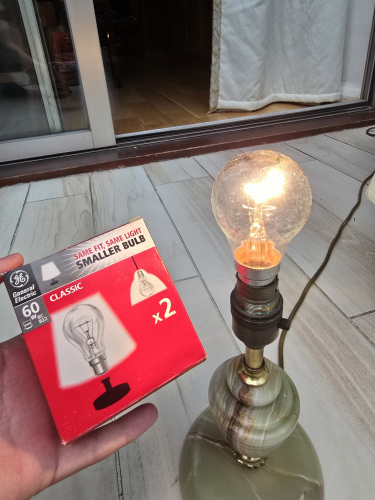
The 40s get super hot on top!
 , these must be worse? , these must be worse?
|
|
|||
|
They also did them in 100W, those really are scorching! I noticed that with the fuses too, they seem to have twin wire link fuses instead which are cheaper than ballotini fuses.
|
|
|||
|
@Angryhorse: Oh definitely, it was hot but I was quick enough to take this pic and then turn it off, plus waited 15 seconds to remove the bulb
  @Beta 5: I can imagine how of a burning hazard it can be if you touch it easily and especially at 100W oh I see, that explains why the GE bulbs trip the circuit breaker but at the same time do not cause further damage to your fixture or the dimmer switch like what happened back 11 years ago when a cheap unfused incandescent bulb was used @Beta 5: I can imagine how of a burning hazard it can be if you touch it easily and especially at 100W oh I see, that explains why the GE bulbs trip the circuit breaker but at the same time do not cause further damage to your fixture or the dimmer switch like what happened back 11 years ago when a cheap unfused incandescent bulb was used
|
|
|||
|
I had a 60W one go EOL a while back and a 40W one too though neither of those tripped the breaker, I guess it just depends on the short circuit current available as to how big of a bang they go with as twin wire fuses should handle it safely like a ballotini fuse

|
|
|||
|
I think it is something to do with the chandelier in the lounge as the electricity feed was at a slight higher voltage or something but yes I've seen GE Hungarian bulbs with twin wire link fuses go EOL without tripping the circuit breaker
|
Comment 1 to 5 of 5 Page: 1 |
 Home
Home Login
Login Album list
 Off topic
 Last comments
 Random
 Most viewed
 My Favourites
 Search