|
|
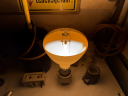
The CDM-T lamp in a T-19 shape undoubtably become for long time one of the most popular lamps used in accent lighting in shops. They were widely used especially in shops selling clothing and other consumer products. Du to the high CRI and color stability as well as a long life these lamps also become very popular for architectural application, like the the immolation of historic building like churches.
Also these lamps were widely used in small fair stands.
However these lamps had one drawback. They were limited to a Power rating of 150W. For buildings were a lots of illumination is needed therefor a compact source quartz metal halide lamp was used. For example the Osram promoted its HTI Lok-It lamps intended for moving-head projectors as the lamps used to illuminate the Brandenburg Gate in Germanys capital city Berlin. However the Life if these lamp is with an average of 750-2000hrs regarding the exact type rather short for a discharge lamp.
Large companies like Siemens, Volkswagen or BMW also looked for a lamp to use at their big stands like the Hannover Messer or the IAA.
By that time Osram already offered larger HCI lamps, the HCI-TS 250W and the HCI-TS 400W. However these seemed to be unpopular.
Osram deamed the demand for these lamps high enough to develop a new lamp range. It would become known as the HCI-TM for the 250W and 400W variety and the HQI-TM for the 600W and 1kW variety. All these lamps were fired in the same physical size The physical size is actually different however all lamps have the same light centre. Allowing a fixture design for all 4 wattages.
The lamps were equipped with an G22 base a GY22 base was in development. The latter would have allowed instand reignition when hot using a 25kV ignitor. If it was ever launched is unknown, however likely it wasn't
The lamps were, similarly to Osram’s other ranges of CMH lamps offered in a in three light colors, 3000K (WDL) 4200K (NDL) and 5900K (D).
The lamps were made at the Radium Factory in Wipperfürth Germany, that at the time also manufactured Osram high power metal halide lamps (HQI-T and HQI-TS 1000W and 2000W) but als some of their HMI lamp.
It seem like the lamps were launched somewhere around 2008. Osram planed to launch an electronic ballast by 2013 for the HCI-TM lamps. Until then it was recommended to run them on normal high pressure sodium chokes (230V mains for the 600W and 1kW variety). I do not know if these ballast ever came and it is believed that these Lamps were never a huge success and failed replacing traditional optical MH lamps from the applications listed above. While the exact date is unknown it is believed that these lamps were discontinued around 2015.
Philips however also developped a 250W CDM lamp comparable to the smaller version of this lamp. However philips used a standard G12 base. Wile the G12 base is not capable to isolate the 25kV present at hot restrique, it allows to use lamps very similar to the stadard CDM series. This is however not possible with the bigger 400W Lamp.
This particular lamp was made in 2012 and already feature as small UV source as starting aid to substitute the Radioactive Kr85 which was omitted due safety regulations.
It uses a classic Osram discharge vessel made from two half spheres of ceramic welded together in the middle. The resulting seem may be seen if the picture is enlarged.
This two part designed simplified manufacturing, reduced the mass of the discharge tube and improved color stability over the lamps life. Osram was the first lamp manufacturer employing this technology. It become standard for Osram CMH lamp by the early 2000s.
Also notable is the coiled lead in wire for the top electrode. This prevents shadows. It also maked the forces from the magnetic field of said wire on the plasma more uniform.
|
|