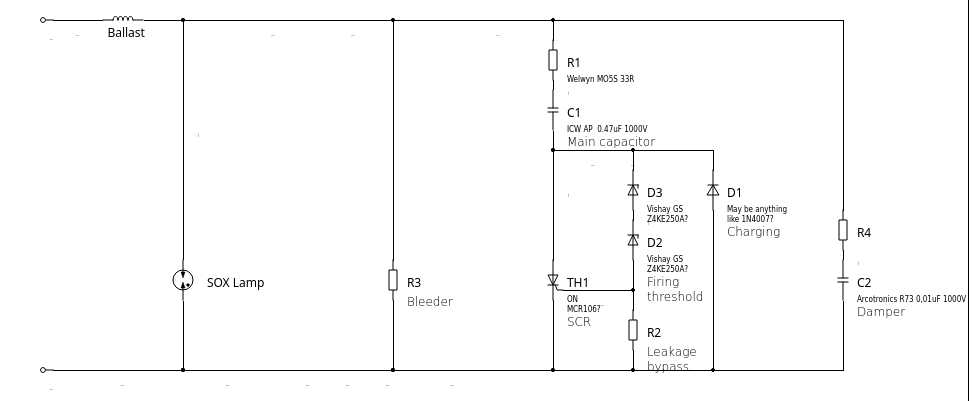
Thorn G53311 schematic redraw
Schematic redraw from picture by Beta5 : http://80.229.24.59:9232/gallery/displayimage.php?album=446&pid=23957#top_display_media

Drawn in Qelectrotech. PM me for the Qet file


General description of how ignitor works (to my understanding) :

Assume lamp is off

In negative half wave (plus on the Neutral) C1 is charging through D1. If nothing else happens, it would charge to 320VDC with plus on the bottom terminal (towards the SCR)

In positive half wave (plus on the Phase) voltage the SCR gets is the line peak voltage + what's charged in C1. If nothing else happens, it would peak at 640V

The SCR gate (assume at same potential as the cathode) is connected to the same capacitor through 2 Zener diodes, probably of 250V. Once the peak voltage exceeds 500V, the diodes will conduct (in reverse) from C1 to the SCR gate and fire the SCR

Once fired, the SCR shorts the 500V (sum of C1 charge + line voltage at that moment) across the line & SOX ballast

C1 discharges in a fast pulse of current. During this pulse, C1 and the ballast form an LC circuit, with resonant frequency way higher than 50Hz. This means that the LC circuit will tend to complete a cycle of a high frequency sine wave, while the line voltage is still pretty much unchanged

The energy is discharged from C1 into the ballast, and in the next stage will be returned to C1, but now with plus on the top terminal

This high voltage appears across the ignitor. The lamp is in parallel to it, so it gets the same pulse


Assume lamp is on

The voltage charged into C1 is now not the peak line voltage but is clamped by the SOX arc voltage. The positive half wave voltage is clamped as well

Together they dont reach to 500V, D1/D2 dont conduct, and the SCR stays off


If C1 keeps charging to a higher voltage than intended when the lamp is on, it (together with the positive line peak) will eventually get to 500V and the ignitor will keep firing

This may happen for several reasons :

 - Rectifying lamp causes higher than expected voltage in one of the polarities. If the lamp is only a little rectifying, the overvoltage may be a relatively short pulse. In this case, try to reverse the lamp polarity in the socket (or the ignitor wiring polarity) and see if anything changes

 - Slightly damaged SCR may react at the wrong voltage

 - Slightly damaged D1/D2 may have increased leakage current, too much for R2 to bypass, causing the SCR to fire at lower voltage

 - R2 may have failed open circuit, allowing whatever small leakage of D1/D2 to fire the SCR at whatever voltage

 - The damper RC circuit may have failed open, not doing its job in reducing overshoots


As a stop gap solution, you may rise the SOX arc voltage threshold by adding an additional Zener diode in series with D1/D2. Few volts or 10..20V may be sufficient

(Too high voltage diode may damage the SCR (if it is indeed MCR106, it is for 600V, but withuot diodes that will fire it at lower voltage, it may end up getting higher voltage than his rating), cause the ignitor to skip pulses, or not work at all), or cause the ignitor to skip pulses or not work at all if C1 never charges high enough to break down the diode at all)


Keywords: Thorn G53311 schematic redraw ignitor sox

Thorn G53311 schematic redraw

Schematic redraw from picture by Beta5 : http://80.229.24.59:9232/gallery/displayimage.php?album=446&pid=23957#top_display_media

Drawn in Qelectrotech. PM me for the Qet file


General description of how ignitor works (to my understanding) :

Assume lamp is off

In negative half wave (plus on the Neutral) C1 is charging through D1. If nothing else happens, it would charge to 320VDC with plus on the bottom terminal (towards the SCR)

In positive half wave (plus on the Phase) voltage the SCR gets is the line peak voltage + what's charged in C1. If nothing else happens, it would peak at 640V

The SCR gate (assume at same potential as the cathode) is connected to the same capacitor through 2 Zener diodes, probably of 250V. Once the peak voltage exceeds 500V, the diodes will conduct (in reverse) from C1 to the SCR gate and fire the SCR

Once fired, the SCR shorts the 500V (sum of C1 charge + line voltage at that moment) across the line & SOX ballast

C1 discharges in a fast pulse of current. During this pulse, C1 and the ballast form an LC circuit, with resonant frequency way higher than 50Hz. This means that the LC circuit will tend to complete a cycle of a high frequency sine wave, while the line voltage is still pretty much unchanged

The energy is discharged from C1 into the ballast, and in the next stage will be returned to C1, but now with plus on the top terminal

This high voltage appears across the ignitor. The lamp is in parallel to it, so it gets the same pulse


Assume lamp is on

The voltage charged into C1 is now not the peak line voltage but is clamped by the SOX arc voltage. The positive half wave voltage is clamped as well

Together they dont reach to 500V, D1/D2 dont conduct, and the SCR stays off


If C1 keeps charging to a higher voltage than intended when the lamp is on, it (together with the positive line peak) will eventually get to 500V and the ignitor will keep firing

This may happen for several reasons :

- Rectifying lamp causes higher than expected voltage in one of the polarities. If the lamp is only a little rectifying, the overvoltage may be a relatively short pulse. In this case, try to reverse the lamp polarity in the socket (or the ignitor wiring polarity) and see if anything changes

- Slightly damaged SCR may react at the wrong voltage

- Slightly damaged D1/D2 may have increased leakage current, too much for R2 to bypass, causing the SCR to fire at lower voltage

- R2 may have failed open circuit, allowing whatever small leakage of D1/D2 to fire the SCR at whatever voltage

- The damper RC circuit may have failed open, not doing its job in reducing overshoots


As a stop gap solution, you may rise the SOX arc voltage threshold by adding an additional Zener diode in series with D1/D2. Few volts or 10..20V may be sufficient

(Too high voltage diode may damage the SCR (if it is indeed MCR106, it is for 600V, but withuot diodes that will fire it at lower voltage, it may end up getting higher voltage than his rating), cause the ignitor to skip pulses, or not work at all), or cause the ignitor to skip pulses or not work at all if C1 never charges high enough to break down the diode at all)

inbound3713256528348389085.jpg IMG_20220121_235851.jpg IMG_20220211_223049.jpg IMG_20220603_230458.jpg 20200905_202200.jpg
File information
Filename:1_g53311.png
Album name:Ash / Schematics
Keywords:Thorn G53311 schematic redraw ignitor sox
Filesize:28 KiB
Date added:17 Dec, 2025
Dimensions:973 x 401 pixels
Displayed:76 times
URL:http://80.229.24.59:9232/gallery/displayimage.php?pid=23962
Favourites:Add to Favourites

Comment 1 to 4 of 4
Page: 1

Beta 5   [18 Dec, 2025 at 08:15 PM]
Thanks for doing this Ash, looks like it would actually be relatively simple to buy the components and make this on some strip board? Might be something I'll have to try at some point.
Ash   [18 Dec, 2025 at 09:04 PM]
Yep. You may not find the exact components, but nearly nothing here is critical to be the exact same, as long as you use functionally equivalent components
Beta 5   [20 Dec, 2025 at 03:35 PM]
I'll have a look and make a list of components from one of the suppliers, perhaps see if they are close enough and then give this a go. If this can be done then that's the replacement low wattage SOX ignitor supply issue solved!
Ash   [20 Dec, 2025 at 06:44 PM]
The few things i already noticed with the 2 critical components :

The SCR is likely an MCR106 or some closely related component, but the marking of the one in the ignitor does not match exactly the marking that gotta be according to the datasheet. Maybe it is some old version that had a different marking

Nowadays it seems that both ON and Littelfuse make them, in 400V and 600V versions. This circuit requires the 600V. (The 400V will break down by itself at 400V, before it even gets triggered by the diodes)

The Vishay GS Z4KE datasheet lists only diodes up to 200V. Maybe the 250V once existed and was discontinued, maybe it was a custom order by Thorn (which they would easily get with the quantities they ordered)

You can use any other combination of Zener diodes that get the same voltage and that can stand the same power, like 3x170 of the same series. Many other Zener diodes for 250V exist too

Comment 1 to 4 of 4
Page: 1

Add your comment
Anonymous comments are not allowed here. Log in to post your comment