|
FILE 1/240 |  |
 |
 |
 |
|
|||
|
 |
||||||||
|
||||||||
|
| File information | |
| Filename: | Screenshot_20260822_130433_Gallery.jpg |
| Album name: | LAllenLighting / Coloured GLS and Halogen lamps |
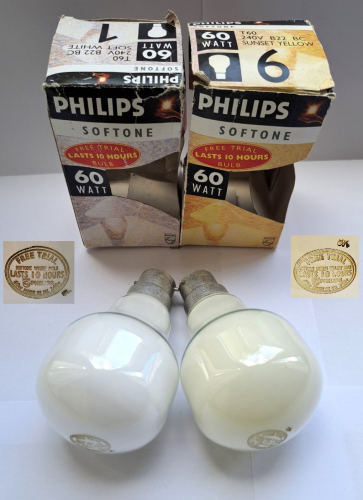
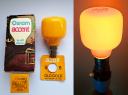
| Manufacturer: | Philips |
| Type/Model: | Softglow/White + Sunset Yellow |
| Wattage: | 60w |
| Date manufactured: | October and November 1998 |
| Filesize: | 306 KiB |
| Date added: | 22 Aug, 2026 |
| Dimensions: | 1020 x 1404 pixels |
| Displayed: | 34 times |
| URL: | http://80.229.24.59:9232/gallery/displayimage.php?pid=25408 |
| Favourites: | Add to Favourites |
Comment 1 to 9 of 9 Page: 1 |
|
|||
|
Makes wonder what failure mechanism is built in and how is it calibrated to 10h. It can't be just driving harder the filaments as that would shift the CCT vs. the lamp being advertised. Atmosphere ? Chip in the lamp base ?
|
|
|||
|
There are two ways to find out what rly goes on so that the 10hr limit is achieved. One is to run it for like 5 minutes and compare the heat output with the standard one of the same 60W power usage. If the trial one seems to feel hotter then the non trial one, defo the case of the filament being overdriven in the trial one. The 2nd method is to put it in an x ray machine to see what the internals consist of, if some chip or fancy fuse like mechanism - it is very interesting what you have come across
|
|
|||
|
Seems wasteful, however it would be interesting to see how long the lamp would last at a lower voltage.
|
|
|||
|
I wonder if these have some sort of impurity in them or release something internally after the 10 hours to poison the atmosphere and burn out the filament?
|
|
|||
|
That might be possible to detect by making a discharge in the gas fill, but the impurity % may be too low to be detectable without high end spectroscope. Other differences may be possible to tell from electrical characteristics when hot / when cold, resonance sound when tapping the lamp (indicating of gas fill pressure) and weight / buoyancy etc. compared to the advertised lamp
|
|
|||
|
The modern version would be a wifi-enabled "smart" LED lamp that requires a subscription to work.
|
|
|||
|
Schneder Electric now have ACB's that require a subscription to work
|
|
|||
|
Wonder if anyone has got the entire colour spectrum of these in collection?
|
|
|||
|
Having posted a photo of these on LG some time ago, here's what the indisputable fountain of knowledge that is James Hooker had to say: "I think they would simply make these lamps with an intentional contamination of a few parts per million of water vapour in the argon-nitrogen fill. I remember when visiting the Philips GLS production at Hamilton and at Weert, the ovens on the exhaust machines of the Softone lines were set much hotter than for regular clear and pearl GLS. Also, in addition to the regular phosphorus pentanitrile getter used on most gasfilled GLS, Softone types also have a dab of zirconium-aluminium getter on the stem to sorb hydrogen contamination. The reason is because the finely divided silica powder coating of the bulb has an extremely large surface area of about 2000 square metres, and this carries a lot of atmospheric moisture into the lamp. The hotter ovens help to drive out most of this, but not all, and the secondary getter is required to make sufficiently clean lamps. Without these two steps, lamp life is drastically reduced to a matter of minutes. So I suspect these free sample lamps are almost identical to regular types, but simply processed at lower temperature - and/or without one or even both of the getters. They should not have photoflood-type overloaded filaments, otherwise their luminous flux and colour temperature would be far higher than normal. That would be kind of dishonest advertising to make the samples so different in light appearance than the regular items!" So yes @Beta 5, you are right!

|
Comment 1 to 9 of 9 Page: 1 |
 Home
Home Login
Login Album list
 Off topic
 Last comments
 Random
 Most viewed
 My Favourites
 Search