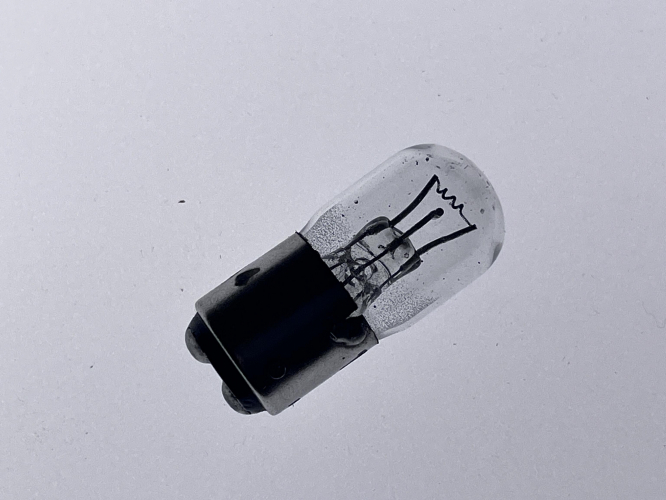
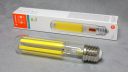
Thorn M1 Low voltage mercury UV source
Here you can see a miniature UV source for low voltage DC application. The lamp was originally developed by Siemens Brothers in the UK as a UV source to excite fluorescent colored panels for example in airplane.

Small UV sources that could be ballasted by standard resistors and be run on the 24V DC of commercial vehicle become interesting during World War II for all major lamp manufacturers.

Night flying over enemy territory at night made it necessary to illuminate aircraft cockpits in ways that made it difficult to see the same from ground or from combat air patrols. The use of normal GLS lamps can make aircraft easily notable against a dark background at night. The solution found was that instruments were marked with fluorescent paints and the cockpits would be lit by long wave UV lamps.

In order to easily be used in an airplane, the lamps needed to have an arc voltage lower then the board voltage and should be capable of running on DC. Both GE and Siemens developed a lamp functioning very similar to another, with the discrepancy of GE using a phosphor on its F5000 lamps while Siemens M1 lamp is clear.

In order to run on low voltage the lamp has a small arc length and low inner pressure. The cathode is a coiled coil tungsten filament with emissive powder which I believe to be very similar to fluorescent cathodes. The anode is a simple wire.
In order to start the lamp the filament is preheated via a a 33Ohm resistor at a maximal current of .95A. After becoming emissive a glow discharge forms between anode and cathode. The discharge current is limited to .8A by a 24Ohm resistor . In order to get the advertised lifespan of 200hrs out of the lamp, the filament heating needs to be disconnected in order to prevent cooking of the emitter.

After the War a second AC operated lamp the M2 was developed. This M1 lamp was continued to be manufactured for other special applications. First under Siemens and after its acquiring of the same under the Thorn name.
The lamps were used in scientific applications as reference for the mercury lines, in insect traps and as exciters for fluorescent materials, minerals and other materials.
To my knowledge these lamps only disappeared in Thorn’s catalogue in the early 1980s.

Thorn M1 Low voltage mercury UV source

Here you can see a miniature UV source for low voltage DC application. The lamp was originally developed by Siemens Brothers in the UK as a UV source to excite fluorescent colored panels for example in airplane.

Small UV sources that could be ballasted by standard resistors and be run on the 24V DC of commercial vehicle become interesting during World War II for all major lamp manufacturers.

Night flying over enemy territory at night made it necessary to illuminate aircraft cockpits in ways that made it difficult to see the same from ground or from combat air patrols. The use of normal GLS lamps can make aircraft easily notable against a dark background at night. The solution found was that instruments were marked with fluorescent paints and the cockpits would be lit by long wave UV lamps.

In order to easily be used in an airplane, the lamps needed to have an arc voltage lower then the board voltage and should be capable of running on DC. Both GE and Siemens developed a lamp functioning very similar to another, with the discrepancy of GE using a phosphor on its F5000 lamps while Siemens M1 lamp is clear.

In order to run on low voltage the lamp has a small arc length and low inner pressure. The cathode is a coiled coil tungsten filament with emissive powder which I believe to be very similar to fluorescent cathodes. The anode is a simple wire.
In order to start the lamp the filament is preheated via a a 33Ohm resistor at a maximal current of .95A. After becoming emissive a glow discharge forms between anode and cathode. The discharge current is limited to .8A by a 24Ohm resistor . In order to get the advertised lifespan of 200hrs out of the lamp, the filament heating needs to be disconnected in order to prevent cooking of the emitter.

After the War a second AC operated lamp the M2 was developed. This M1 lamp was continued to be manufactured for other special applications. First under Siemens and after its acquiring of the same under the Thorn name.
The lamps were used in scientific applications as reference for the mercury lines, in insect traps and as exciters for fluorescent materials, minerals and other materials.
To my knowledge these lamps only disappeared in Thorn’s catalogue in the early 1980s.

1000002790.jpg Screenshot_20250604_142440_Gallery.jpg THORN_M2.jpeg 387A9729b.jpg 387A9821b.jpg
File information
Filename:THORN_M2.jpeg
Album name:Alex / UV and IR sources
Manufacturer:Thorn
Type/Model:M1
Filesize:2285 KiB
Date added:03 Jun, 2025
Dimensions:2730 x 2048 pixels
Displayed:433 times
URL:http://80.229.24.59:9232/gallery/displayimage.php?pid=23108
Favourites:Add to Favourites

Comment 1 to 5 of 5
Page: 1

Slyspark   [03 Jun, 2025 at 06:23 PM]
Interesting. 200hrs is a very short lifespan for a lamp - I guess the replacement frequency was well before the 200hr mark tho to ensure no premature failures
Alex   [04 Jun, 2025 at 06:10 AM]
I personally think that the limiting factor is not the electrical side but degradation in the glass reducing the UV transmission
Beta 5   [04 Jun, 2025 at 09:39 AM]
Nice little lamp, have you lit it at all? Fascinating to see the solutions they came up with for problems like this back then!
Slyspark   [04 Jun, 2025 at 06:28 PM]
Ah, yes, I spose it might blacken the glass quite fast and that's why it had only a 200hr lifespan before it became ineffective
Andy   [04 Jun, 2025 at 08:04 PM]
That's an interesting lamp that I was unaware of. Good to know its history and method of operation. Smile

Comment 1 to 5 of 5
Page: 1

Add your comment
Anonymous comments are not allowed here. Log in to post your comment