|
|
Thorn M1 Low voltage mercury UV source
|
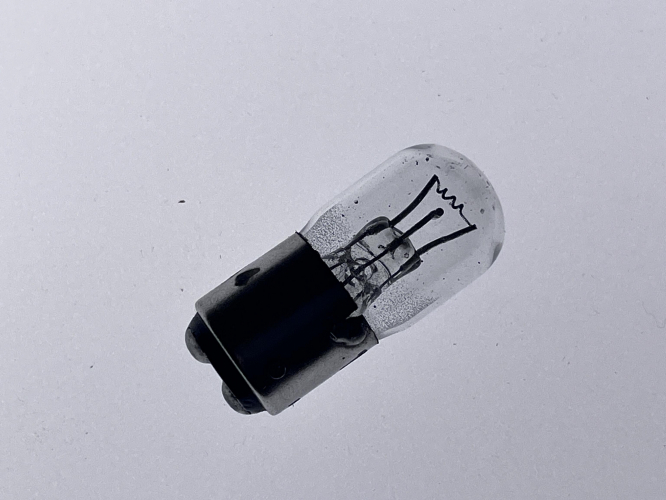
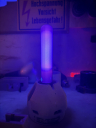
Here you can see a miniature UV source for low voltage DC application. The lamp was originally developed by Siemens Brothers in the UK as a UV source to excite fluorescent colored panels for example in airplane.
Small UV sources that could be ballasted by standard resistors and be run on the 24V DC of commercial vehicle become interesting during World War II for all major lamp manufacturers.
Night flying over enemy territory at night made it necessary to illuminate aircraft cockpits in ways that made it difficult to see the same from ground or from combat air patrols. The use of normal GLS lamps can make aircraft easily notable against a dark background at night. The solution found was that instruments were marked with fluorescent paints and the cockpits would be lit by long wave UV lamps.
In order to easily be used in an airplane, the lamps needed to have an arc voltage lower then the board voltage and should be capable of running on DC. Both GE and Siemens developed a lamp functioning very similar to another, with the discrepancy of GE using a phosphor on its F5000 lamps while Siemens M1 lamp is clear.
In order to run on low voltage the lamp has a small arc length and low inner pressure. The cathode is a coiled coil tungsten filament with emissive powder which I believe to be very similar to fluorescent cathodes. The anode is a simple wire.
In order to start the lamp the filament is preheated via a a 33Ohm resistor at a maximal current of .95A. After becoming emissive a glow discharge forms between anode and cathode. The discharge current is limited to .8A by a 24Ohm resistor . In order to get the advertised lifespan of 200hrs out of the lamp, the filament heating needs to be disconnected in order to prevent cooking of the emitter.
After the War a second AC operated lamp the M2 was developed. This M1 lamp was continued to be manufactured for other special applications. First under Siemens and after its acquiring of the same under the Thorn name.
The lamps were used in scientific applications as reference for the mercury lines, in insect traps and as exciters for fluorescent materials, minerals and other materials.
To my knowledge these lamps only disappeared in Thorn’s catalogue in the early 1980s.
|
|



 Home
Home Login
Login Album list
 Off topic
 Last comments
 Random
 Most viewed
 My Favourites
 Search